
After Bedtime: Gratitude Was Never the Problem
Loving your motherhood, your kids, your partner does not mean accepting the bare minimum as a love language.

If you’re new here, this is our weekly note for the mother after the mothering is done—or, more realistically, after the children are finally asleep and the dishwasher is running and someone has abandoned one sock in the hallway and your brain is still holding 47 tabs that no one else can see (because, we know better than to think we’re ever “done”).
In case you missed us last week—our first issue—we’re here for the woman inside the role of “mom.” The one who loves her children so much it physically aches and still misses parts of herself, who’s carrying the calendar, feelings, birthday gifts, sunscreen, ambition, resentment, group chat, guilt and the question of whether she is allowed to want more without sounding ungrateful. Which brings us to this week.
By Wednesday morning, the comment section had basically written the next issue for us.
If you missed the chaos: we posted a few things around Mother’s Day. One about the way moms in the thick of raising young kids are so often expected to manage the holiday for everyone else, including grandmothers and mothers-in-law. One was a Mother’s Day weekend survival guide for dads who’d like to remain married by Monday (that got some laughs). One was about the very specific comedy of the last-minute Mother’s Day gift. One about wanting to be noticed in the actual life you’re living, not just handed flowers while the dishwasher is full. One about the mother who does not fit neatly inside the greeting card.
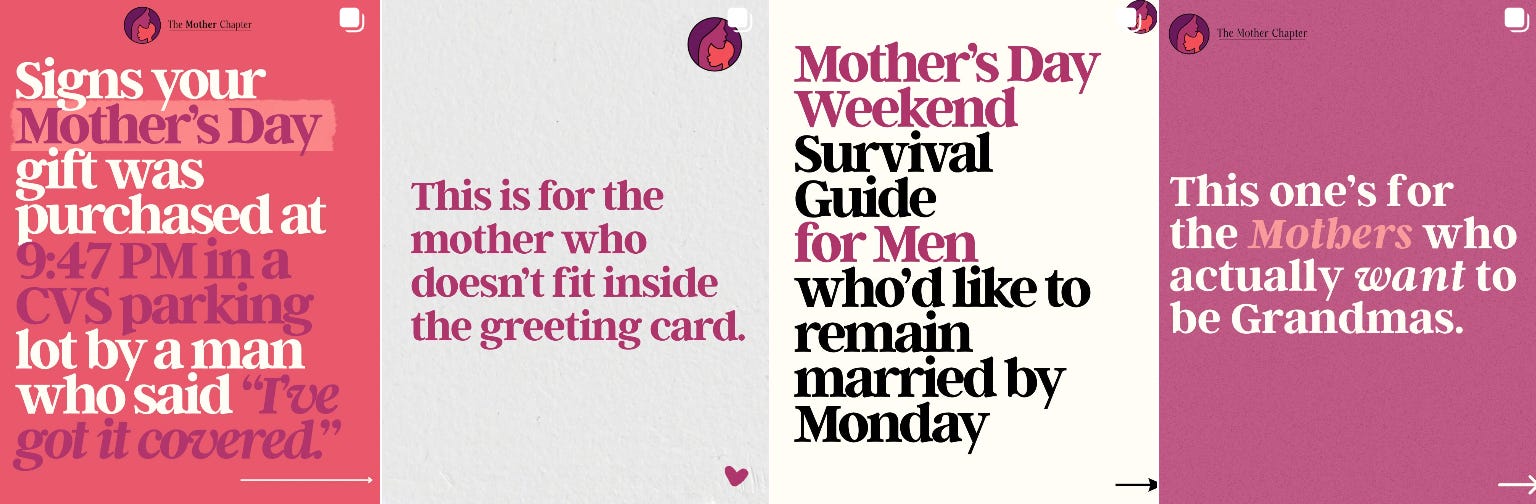
All of these posts were valid, because all of these posts speak to mothers somewhere along their own, individual journey. They were funny, they were exaggerated and they were also, apparently, a little too accurate.
A lot of mothers got it immediately and understood that the point was never “grandmothers don’t matter” or “men are useless” or “homemade cards are not enough.” They saw what we were really talking about, which is the way moms are all-too-often expected to create the magic, manage the expectations, absorb the disappointment, make everyone else feel celebrated and then accept whatever is left for them with a smile—especially on a day meant to honor them.
But then came the other comments. The ones telling mothers to “just be grateful.” The ones calling women entitled for wanting effort. The ones rushing to defend the hypothetical father who “works hard to support his family,” as if the mother in question is not also working, supporting, carrying, earning, managing, noticing, planning, remembering and holding the entire emotional infrastructure of the home.
And that was the part that stayed with us: how quickly so many people could imagine the father’s exhaustion, the grandmother’s feelings, the partner’s intentions, the giver’s effort, and how slowly they were willing to imagine the mother’s.
No one asked if maybe she, too, supports the family. They just told her to be grateful. Which is funny, in the least funny way, because mothers are grateful—like embarrassingly grateful, cry-in-the-car-after-the-preschool-concert grateful, keep-every-card-in-a-box grateful, watch-them-sleep-and-feel-your-heart-leave-your-body grateful…
We love our children, our families, our husbands, partners, co-parents, the people we are building this life with…But somewhere along the way, gratitude became the thing people say when they want mothers to stop talking.
Be grateful he did anything.
Be grateful you have children.
Be grateful you have a partner.
Be grateful someone remembered.
Be grateful it was not worse.
The rhetoric felt almost antique—like someone opened a dusty drawer from 1956 and pulled out the idea that a good mother should smile, serve, absorb and never make anyone uncomfortable by wanting anything for herself.
Except it is 2026. Mothers work. Mothers earn. Mothers lead companies. Mothers build brands. Mothers run meetings with spit-up on their sleeve and a pediatrician portal open in another tab. Mothers are still doing the laundry, still ordering the camp labels, still tracking the emotional weather of the house, still making the magic, still being told they are “so lucky” when what they are asking for is not luxury.
The Thing We’re Saying Out Loud
Good partners are not the enemy. Low expectations are.
A mom saying she wants (or even expects) a little effort is not an attack on every man who’s ever packed a lunch, done bedtime, held a baby, booked a reservation, folded laundry or loved his family well.
But the speed with which people rush to defend the hypothetical tired, overworked father while dismissing the very real tired mother says a lot. Especially when that mother may also be working, earning, supporting the household, managing the children, carrying the invisible labor and holding together the emotional infrastructure of the family. And even if she is not working outside the home, let’s be very clear: stay-at-home motherhood is work (like relentless, physical, emotional, invisible work!).
We are not here to bash good men. We know good men exist and, in fact, many of us are married to them. I, for one, am married to an incredibly loving, supporting, kind, one-of-a-kind man who goes above and beyond for me and my kids every day—not just Mother’s Day. For some reason so many comment attackers were all over us as if the person behind the brand was somewhere sitting in a closet eating cookies and confessing about her sh*t husband.
The Mother Chapter is not a diary entry about one marriage—it is a platform for the modern mother, and so many modern mothers are drowning in the gap between how much they carry and how little of that carrying gets seen.
We’re not here to discuss good men versus bad men, flowers versus no flowers or whether mothers love their children enough to shut up and smile. We are talking about a culture that still asks mothers to expect less, accept less and call it gratitude.
A mother can be grateful and still have standards. That is not entitlement—it’s having a pulse.

The Mother’s Day postmortem you did not ask to host.
The teacher gift situation, which has somehow become a part-time job.
The mineral sunscreen from last year that may or may not be expired but has entered the chat anyway.
The camp form that requires information only the mother appears to know.
The Father’s Day gift planning that will somehow be treated as a national infrastructure project.
The text you meant to answer before the comment section became your second job.
The laundry that’s been “almost done” since Tuesday.
The quiet realization that everyone in the house knows where to find you, but no one knows where to find anything else.
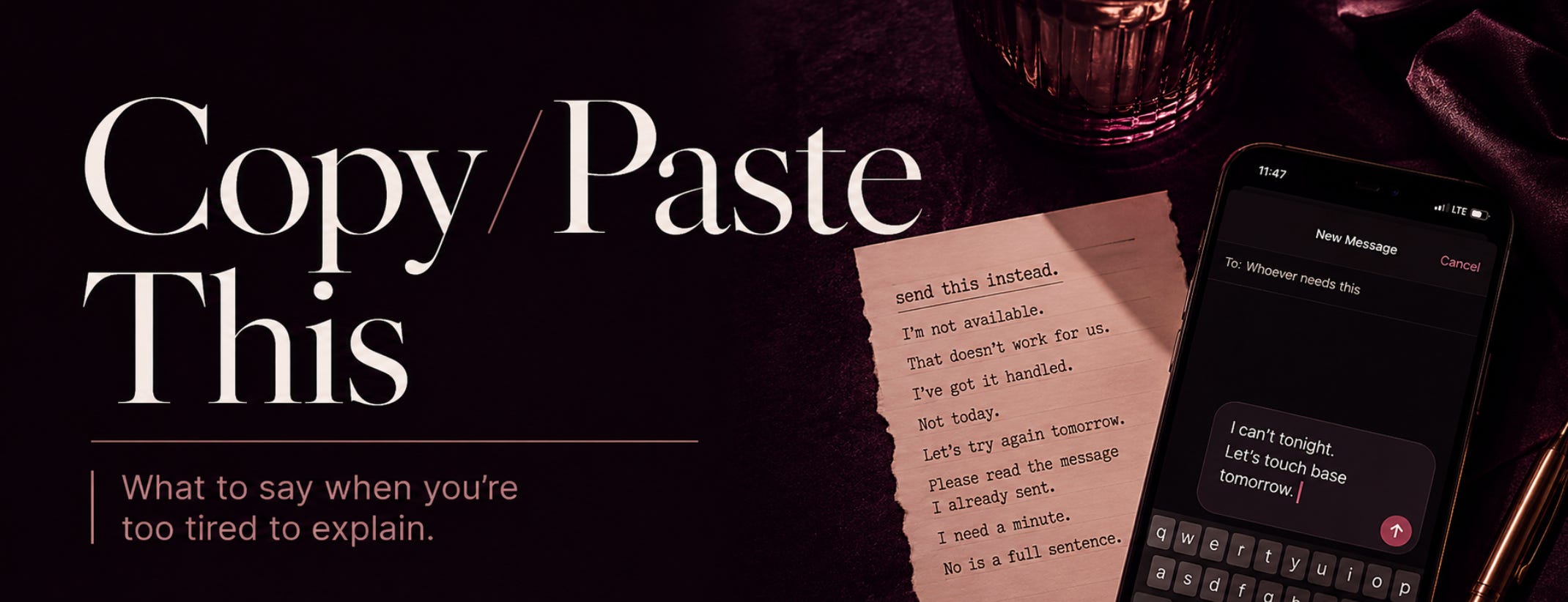
For the person who says, “You should just communicate what you want”:
“I agree that communication matters, but there’s a very real difference between expressing your needs and having to manage every detail of how someone appreciates you. What many moms are asking for is not mind-reading—it’s thoughtfulness and someone noticing, planning and caring without needing a full set of instructions.”
For the person who asks, “So is The Mother Chapter actually for me?”
“The Mother Chapter is for the mother who loves her children deeply and still wants space to talk about what motherhood has changed in her. It’s for the woman who is grateful for her family and still wants to be seen inside it—the one thinking about identity, marriage, ambition, beauty, bodies, work, friendship, grief, reinvention, resentment, joy and the quiet mental load that follows her into every room. It’s for mothers who want honesty without cruelty, humor without denial, and conversations that do not require them to shrink their needs in order to prove they love their children.
So yes, if you believe mothers are allowed to be whole people, you’re probably in the right place. And if every honest thing a mother says reads to you as complaining, entitlement or an attack on someone else, this may not be the corner of the internet for you.”
Save it. Send it. Use it as a starting point.
What is the smallest thing someone has done for you that made you feel genuinely seen as a mother?
Hit reply and tell us. We may share a few responses, anonymously, in next week’s issue.

A few things for the mother after the mothering.
The women’s health headline worth sending to the group chat
PCOS has a new name: PMOS, short for polyendocrine metabolic ovarian syndrome. The point of the rebrand is not just semantics, but rather an attempt to move the conversation away from “cysts” and toward the bigger hormonal and metabolic picture so many women have been trying to explain for years. Translation: once again, women were not being dramatic. The system was being too narrow.
The book for the good dad who wants to be even better
The Tired Dad by Jon Gustin is newly out, and honestly, it feels like a useful counterpoint to this whole week’s comment-section discourse. We’re not anti-dad. We are very pro-dads who are trying, reflecting, showing up, doing the work and not making their partner carry the entire emotional instruction manual. A very solid Father’s Day “I love you and also please read this” candidate.
The AI read for the women who are already carrying too much
The Cut had a smart piece this week on the “girlbossification of AI”—aka the sudden flood of famous women telling other women to get on board or get left behind. Worth reading if you have ever wondered whether technology is being sold to women as liberation while quietly becoming one more thing we are supposed to master before breakfast.
The official motherhood resource we’re side-eyeing
Moms.gov launched around Mother’s Day as a federal resource for new and expecting mothers. We’re always in favor of mothers having access to real support, but we’re also always going to notice when moms are spoken to as a category to be managed, advised or morally instructed instead of as whole people with bodies, needs, choices, histories and actual lives. Bookmark it if useful—keep asking better questions anyway.
The “someone please make the house stop asking me questions” calendar
The Skylight Calendar, aka digital family calendar, command center and shared planning system for the household where everyone can see the dentist appointment, the camp theme day, the school concert and the fact that Friday is somehow “wear green” day is incredible for young families. The real gift is not even the calendar itself—it’s no longer being the only person who knows what is happening.
Some links may be affiliate links, which means The Mother Chapter may earn a commission if you buy through them. We only share things we’d send to a mom friend without needing to over-explain.

Maybe you’re deeply grateful for your life. Maybe you look at your children and feel something so enormous it almost scares you. Maybe you love your partner. Maybe you know he’s a good one—a keeper who works hard. Maybe you’re not trying to turn your marriage into a comment-section debate or your disappointment into a public trial.
And maybe you still want more—noticing, planning, care that arrives before the reminder, evidence that the person behind the mothering is still visible in the house she helps hold together. Both things can be true.
You can love your children and want to be loved well by the adults around you.
You can be grateful and tired of being told gratitude is the only acceptable response.
You can appreciate effort and still know when the bar is underground.
You can adore motherhood and still refuse to disappear inside it.
That is the conversation we want to have here.
Send this to the mom who doesn’t need another parenting tip. She needs a place that remembers she exists, too.